If you manage a commercial building in Toronto, you’ve probably dealt with fire inspections, false alarms, or a panel that suddenly shows “trouble” at the worst time. A lot of those problems come down to the same thing: people don’t really understand what parts make up a fire alarm system, what each one does, and how they work together.
At Fire Safety Solutions, we have prepared a detailed guide that breaks down the main components of a fire alarm system for Toronto and Ontario business owners and property managers who need clarity without getting buried in jargon. Let’s dive in!
Why You Need to Know the Components of Fire Alarm Systems
Fire alarm systems, Toronto buildings use, are typically built to meet Ontario Building Code and Ontario Fire Code expectations, plus any site-specific requirements from the local authority having jurisdiction. The goal is simple: detect fire early, notify people clearly, and trigger the right building responses consistently. Understanding what components make up a fire alarm system and how they interact together can help to identify weaknesses, ask better questions, and avoid recurring issues over time.
Full Commercial Fire Alarm System Components List
If you are looking for a straightforward fire alarm system components list, here are the categories that show up in almost every commercial system:
- Initiating devices (detection and manual activation)
- Fire alarm control unit/fire alarm control panel (FACU / FACP)
- Notification appliances (horns, strobes, speakers, etc.)
- Power supplies (primary and backup)
- Supervisory and monitoring interfaces (including off-site monitoring where required)
- Wiring and circuits (SLC, NAC, IDC, communications)
- Ancillary and emergency control functions (elevators, doors, smoke control, fan shutdown)
The 5 Components That Make Up a Fire Alarm System
If you are looking for a simplified version, here are the 5 main components of a fire alarm system:
- Detection and initiation
- The control panel (the decision-maker)
- Notification (how people are warned)
- Power (so it works during outages)
- Monitoring and supervision (so issues are caught and signals reach the right place)
You will see these five in almost every fire alarm system, even if the building is small. Let’s take a closer look at each.
Component 1: Initiating Devices (Detection and Manual Activation)
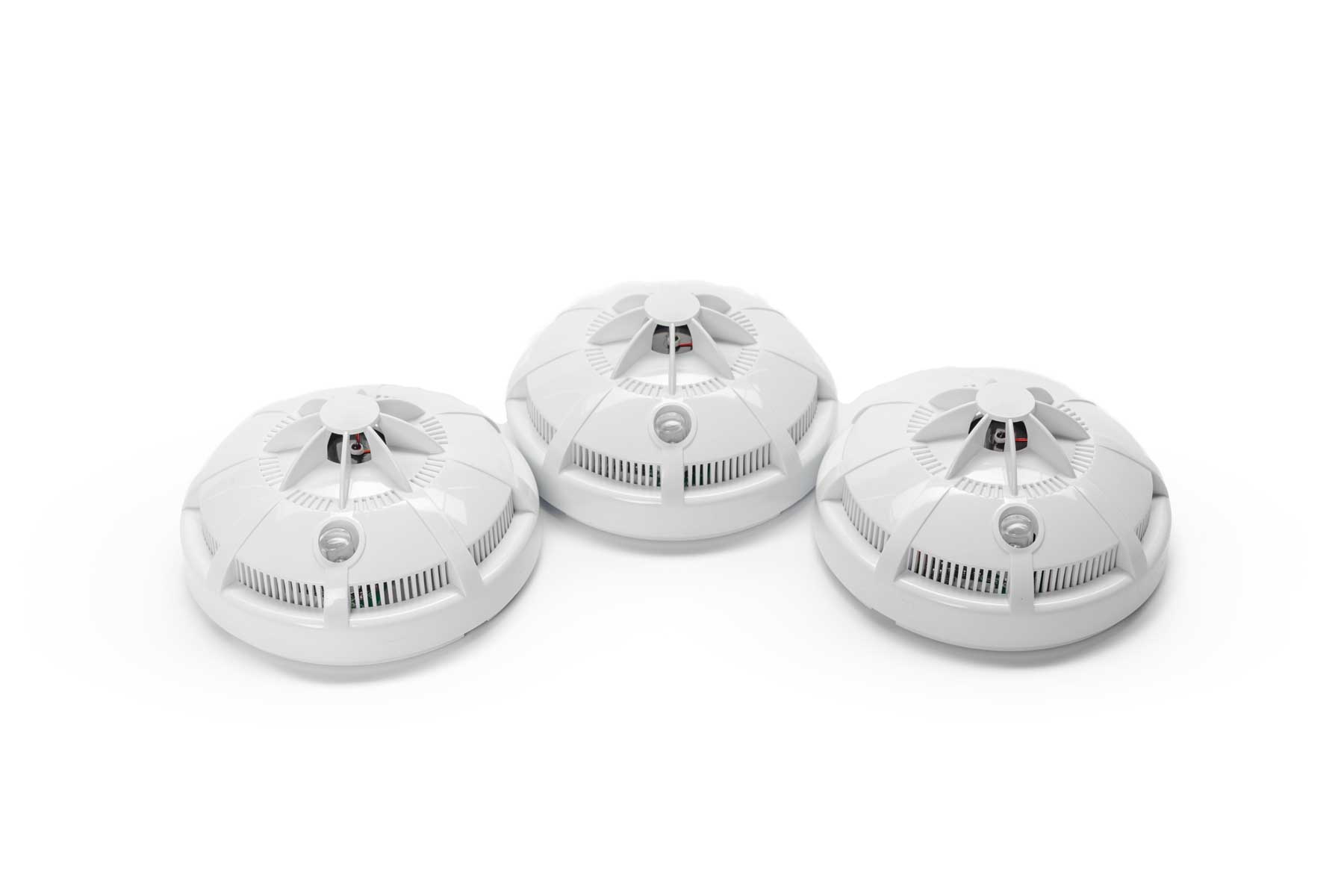
Initiating devices are what tell the system something is happening. In commercial settings, these usually include:
- Smoke detectors (photoelectric and/or ionization, depending on application )
- Heat detectors (fixed temperature and rate-of-rise)
- Manual pull stations
- Waterflow switches (when sprinklers activate)
- Supervisory switches (valves closed, pressure issues, etc.)
- Duct detectors (common in HVAC systems)
- Beam detectors or specialty detectors (in large open areas)
Component 2: Fire Alarm Control Unit (FACU / Panel)
The fire alarm control unit is the brain of the system: it collects signals from initiating devices, processes them, and triggers outputs like horns/strobes, elevator recall, door releases, or signals to monitoring.
You’ll usually see three conditions on the panel:
- Alarm: active fire event (or something that the system interprets as one)
- Supervisory: a fire protection system condition that needs attention (like a closed sprinkler valve)
- Trouble: a fault in the fire alarm system itself (ground fault, device missing, circuit issue, low battery, etc.)
Component 3: Notification Appliances (Signals People Can Actually Understand)
Notification is where systems succeed or fail from an occupant’s point of view. A fire alarm that “technically works” but isn’t clearly heard or seen in key areas creates real risk.
Notification appliances can include:
- Horns
- Bells
- Strobes (visual)
- Speakers (for voice evacuation)
- Combination of horn/strobes or speaker/strobes
Notification devices are typically powered and controlled through notification appliance circuits (NACs).
Component 4: Power Supply (Primary and Backup)
A fire alarm system is expected to keep functioning during power interruptions. Power components usually include:
- Primary power source (typically building electrical service)
- Backup batteries sized for the required standby and alarm time
- Power supplies/boosters (especially for large systems with many notification devices)
- Chargers and battery supervision
In practice, battery issues are one of the most common reasons a panel shows trouble. Batteries age, get undersized after expansions, or aren’t replaced on schedule. If you’re seeing recurring battery troubles, it’s worth reviewing battery calculations and expansion history instead of just swapping batteries and hoping for the best.
Component 5: Monitoring and Supervision
Monitoring isn’t the same as the fire alarm system itself, but it is closely related to the system’s function and compliance requirements. Monitoring may involve:
- A communication path from the panel to a supervising station (cellular, IP, dual-path, etc.)
- Signal handling procedures for alarm, supervisory, and trouble
- Redundancy (so one outage doesn’t cut off signals)
The “supervision” function includes the system’s ability to detect faults in wiring, device communications, and power before they become failures.
Addressable Fire Alarm System Components vs. Conventional
A lot of Toronto buildings use addressable systems today, especially mid-size to large commercial and multi-residential properties. Here are the main differences between conventional and addressable fire alarm system components:
Conventional System Components
- Devices are grouped into zones.
- The panel can identify the zone in alarm, not the exact device.
- Wiring is simpler, but it can be limiting in troubleshooting and expansion.
Addressable System Components
- Each device has a unique address.
- The panel can pinpoint the exact device in alarm or trouble.
- More flexible programming, easier diagnostics, and more potential for expansion.
A Practical Checklist You Can Turn into a PDF
Many of our clients ask for a fire alarm system components PDF to share internally. If you’re building one for your site binder or maintenance manual, include:
- A labelled device map (detectors, pull stations, notification devices)
- Panel location and panel model
- Circuit types (SLC/NAC/IDC) and any booster panels
- Monitoring method and contact information for the supervising station
- Battery type, installation date, and replacement schedule
- Recent verification and inspection reports
- Known trouble history (recurring issues and what was done)
It sounds basic, but when a contractor changes, a tenant renovates, or a panel trouble shows up at 2 a.m., that one-page reference saves time and reduces mistakes.
Final Word
Understanding the components of fire alarm systems helps you make better decisions when you are comparing quotes, managing maintenance, or dealing with recurring issues. If you manage a building in Toronto, treat your fire alarm system like critical infrastructure – document the parts and understand what they are doing and why. If you have any questions, don’t hesitate to reach out to Fire Safety Solutions – we would be happy to walk you through your system, review your current setup, and help you understand any issues or upcoming requirements.
Contact Us
Have a project we can help with?
Give us a call or reach out to us on social media.
Address
Head Office
25 Edilcan Drive, Unit #8
Concord ON, L4K 3S4
Cambridge Office
180 Shearson Crescent, Unit 3
Cambridge ON, M1T 1P4