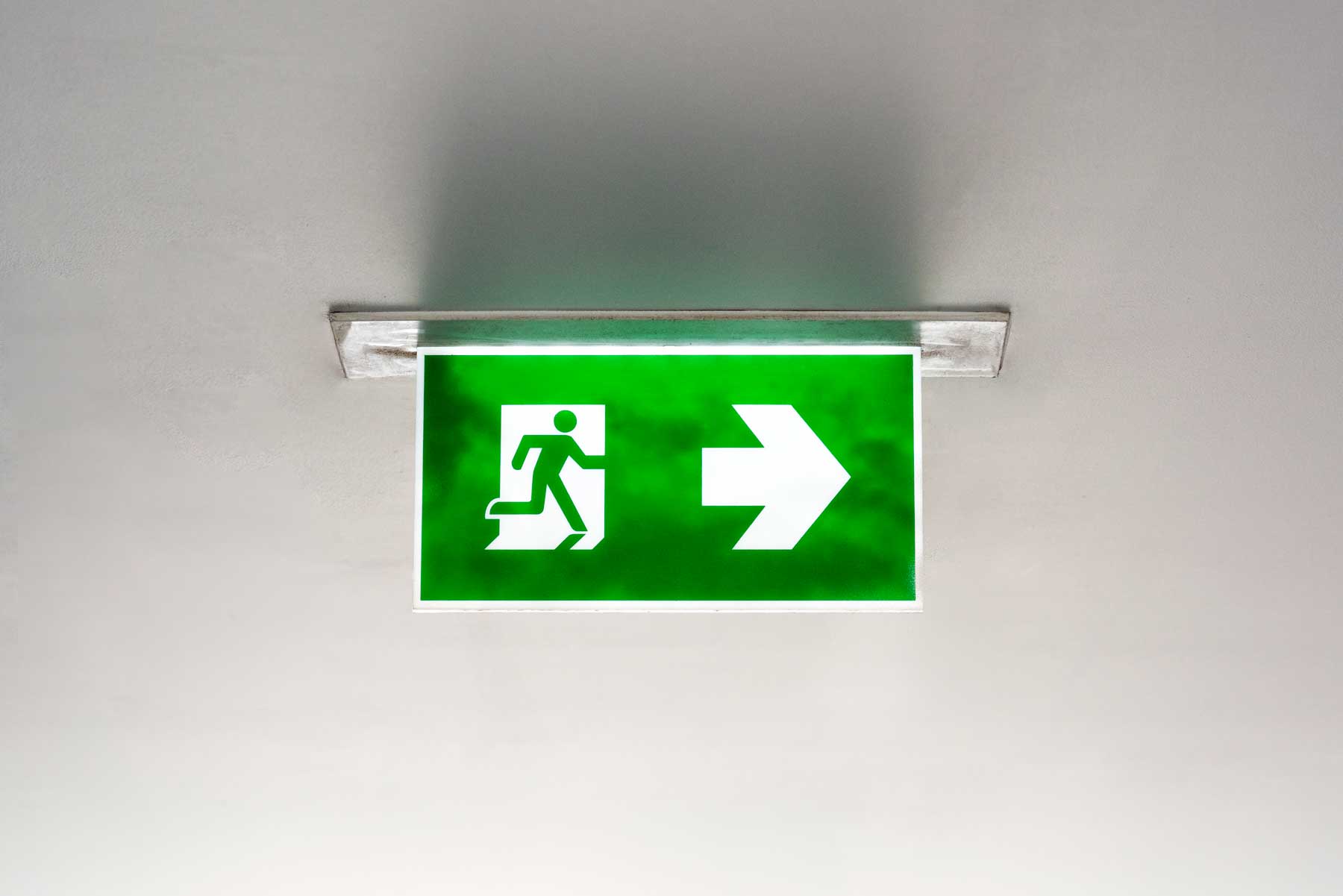
Exit signs are one of those building features people only notice when something goes wrong – failing to recognize that they serve as a life-saving navigation during a power failure, smoke event, or evacuation.
At Fire Safety Solutions, we treat exit signage (and the lighting that supports it) as life safety infrastructure, not décor. In this article, we are going to cover emergency exit signs requirements in Ontario and Toronto, as well as explain the differences between “exit signs,” “exit lighting,” and “emergency lighting” – a common source of confusion among Toronto property managers and building owners.
What Are Exit Signs?
Exit signs are devices installed in buildings to clearly identify the location of exits and the direction of travel to reach them. Their purpose is to guide occupants along the required means of egress so that they can leave the building safely during an emergency.
In Ontario, exit signs typically display the word “EXIT,” “SORTIE,” or an approved pictogram, and may include directional indicators like arrows. Exit signs are required to be illuminated when the building is occupied and must remain visible, identifiable, and unobstructed at all times. They are not decorative elements; they are life safety devices regulated by the Ontario Building Code and maintained under the Ontario Fire Code.
Are Exit Signs Required in Toronto Buildings?
Exit signs are often required in Toronto buildings – but not always. Ontario Building Code exit sign requirements apply based on building characteristics and how the exit serves the space. In plain terms, exit doors typically need signage when they serve:
- a building with more than 2 storeys
- a building with an occupant load of more than 150
- a room or floor area where a fire escape is part of a required means of egress
As such, many commercial properties and multi-residential buildings in Toronto end up with exit signs at most required exits.
6 Rules for Emergency Exits You Must Follow
1. Building Code Exit Sign Requirements: What the Sign Must Do
Ontario’s exit sign code requirements focus on usability:
- The sign must be visible on the approach to the exit.
- It must clearly identify the exit door or exit route.
- It must remain illuminated under the conditions required by code .
Visibility sounds obvious, but in real buildings, it’s where problems start. Bulkheads, feature walls, open-concept renovations, and even seasonal décor can block sightlines. If you can’t see the sign until you are directly underneath it, you’ve defeated the point.
2. Exit Sign Location Requirements: How Many Exit Signs Are Required?
There is no specific number of exit signs required in a building. Instead, exit signs must be placed at locations where people make decisions and where the route could be misunderstood. At minimum, every exit door needs an exit sign placed over or adjacent to it (with limited exceptions in the Code). Beyond that, it is recommended to add directional signage at corridors, intersections, and points where occupants could mistakenly head toward dead ends.
3. Exit Sign Height Requirements: What People Mean vs. What Code Actually Enforces
A lot of people search “exit sign height requirements” expecting a universal mounting height (for example, “X inches from the floor”). In Ontario, the practical requirement is that the sign is placed so it’s visible on approach, not blocked, and readable at the needed distance. The Code also addresses letter size and stroke width depending on the sign type (internal vs. external illumination), which is what ultimately drives readability.
4. Exit Sign Lighting Requirements
This is where people mix up three related concepts:
- Exit signs (the sign itself)
- Exit lighting (normal lighting along the egress route)
- Emergency lighting (lighting that operates on backup power during an outage)
Ontario requires exit signs to be illuminated continuously while the building is occupied. For externally illuminated exit signs (signs lit by an external fixture rather than internally lit), the Building Code calls for continuous illumination by a dedicated light fixture and ties the circuit requirements to emergency power conditions.
5. Emergency Exit Signs Requirements Ontario: Inspection and Testing
Even if your building was designed correctly, ongoing exit sign testing and maintenance make sure the system remains functional. As such, Ontario’s Fire Code regulation includes inspection and testing expectations for emergency lighting. National Fire Code guidance also outlines routine inspection concepts for exit signs, including ensuring they remain visible and not obstructed, and that they are tested to confirm performance during emergency power durations.
6. Another Requirement that Exit Routes Must Meet: Energy Efficiency
Exit signs are considered to be regulated products under federal energy efficiency rules. Natural Resources Canada publishes requirements for exit signs, including definitions for Type 1, Type 2, and Type 3 exit signs, and links the standards to CSA performance testing.
Why does this matter?
- If you are replacing exit signs during a retrofit, you want compliant models.
- If you are sourcing products, the energy performance requirements can affect what’s allowed to be sold or installed.
- Switching older signs to compliant LED models could reduce ongoing electrical load without compromising visibility.
Common Exit Signs Problems
A few problems show up repeatedly in Toronto buildings:
- Obstructed signs: signs hidden by décor, storage, banners, or tenant displays (especially in retail and amenity spaces).
- Mismatched signage: mixing older red “EXIT” styles with newer pictogram-style signage in the same area can create inconsistent messaging.
- Poor placement after renovations: corridors rerouted, exits relocated, but signs not updated.
- Power and circuit problems: signs that appear illuminated under normal power but fail on backup conditions (or the opposite).
- Overconfidence in “glow” signs: photoluminescent or specialty signs have their own standards and limitations and are not simply drop-in replacements for internally illuminated signs.
Final Word on Requirements for Exit Signs in Ontario
Exit signs and exit lighting play a crucial part in the life safety of building occupants. Unfortunately, most exit sign issues are easy to overlook, as they arise from gradual changes rather than sudden failures – obstructed signage, outdated fixtures, or layouts that no longer match the original design.
If you want to make sure that your building’s exit signage remains compliant and effective, or have questions about exit sign requirements in Ontario, don’t hesitate to reach out. Fire Safety Solutions experts can help you review your current setup and understand what adjustments may be needed to stay compliant. Get in touch now.
Contact Us
Have a project we can help with?
Give us a call or reach out to us on social media.
Address
Head Office
25 Edilcan Drive, Unit #8
Concord ON, L4K 3S4
Cambridge Office
180 Shearson Crescent, Unit 3
Cambridge ON, M1T 1P4